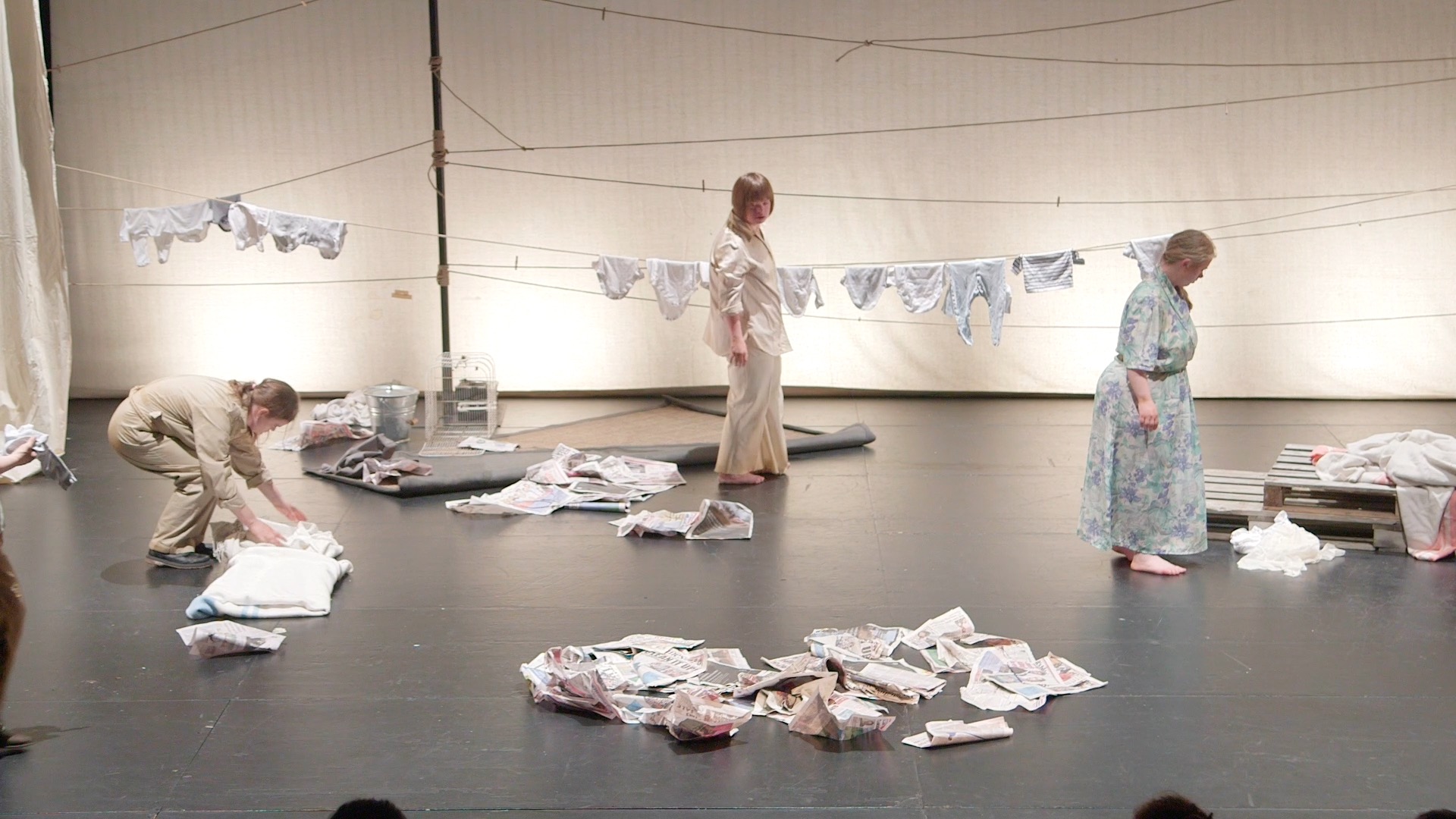
 Gemma Gallagher/Shadowbox, 'Somethings', 2017 at Mermaid Arts Centre. Photo: Gemma Gallagher
The Arts Council uses the term arts and disability to cover how people with disabilities participate in the arts and how the mainstream arts sector gives consideration to people with disabilities in all aspects of its work. The term encompasses a range of arts practices and activities involving people with disabilities as artists, participants, arts workers, and audience members. It embraces a wide range of contexts including disability arts, Deaf arts, disability-led practice, collaborative practice, access services, and advocacy.
In 2012, the Arts Council published an updated policy and five year strategy Arts and Disability (2012 - 2016). It was developed in consultation with a wide range of stakeholders and it is envisaged that the Arts Council will work in partnership with the sector in its implementation.
The policy is built on a number of key values including:
- Equality - a commitment to ensuring that people with disabilities can engage fully in the artistic and cultural life of Ireland at all levels in line with Article 30 of the UN Convention on the Rights of Persons with Disabilities.
- The Social Model of Disability - a recognition that access must be considered at the earliest planning stages so that barriers to participation are not created or further perpetuated.
- Complexity and diversity of people and practices - an understanding that the sector is made up of artists, participants and audiences of all ages with physical, sensory, intellectual and mental health impairments as well as a wide range of people working professionally and voluntarily in the arts and disability sectors. The Arts Council is committed to the provision of support for an evolving range of artistically ambitious practices.
- Holistic approach - a commitment to the mainstreaming of access and participation in parallel with the provision of strategic targeted supports and a process of capacity building.
- Inclusion - a commitment to Arts and Disability as part of the larger commitment to social inclusion.
Funding
There are a number of key agencies, funded by us, who have a central role in supporting these areas of work including Arts and Disability Ireland. Other funded organisations such as venues, local authority arts officers, festivals, and production companies have an important role in improving access through programming arts and disability work and targeting people with disabilities as artists, participants and audiences.
The Arts Council offers a wide range of financial supports across artforms and arts practices, including Arts and Disability. Those supports, direct and indirect, that are available are described in detail in available funding. They include bursaries, projects, and travel and training awards as well as specific schemes including Ignite and Arts_and_Disability_Connect_Scheme . In addition, the Artist in the community scheme, offers opportunities for artists and groups to work alongside each other in the making of collaborative art. It is externally managed by Create.
IGNITE! Commissioning Scheme
Following a major funding commitment by the Arts Council for 2013 and 2014, the Arts Council, Arts and Disability Ireland (ADI), Cork City Council, Galway City and County Councils, and Mayo County Council worked together to create Ignite.
This is a unique and innovative approach to commissioning and touring ambitious new work by artists with disabilities. Ignite builds on an Arts and Disability Networking model rolled out in each of the local authority areas over the past 5 years, and has been made possible with additional financial investment from each of the local authorities and ADI.
Ignite will support collaborative commissions to create new work, led by internationally recognised artists with disabilities. The artists will work in tandem with Arts Council-funded local venues, organisations and festivals in Cork city, Galway and Mayo as well as with the local disability communities and groups. There will be three commissions in total, each to the maximum value of €60,000. Further details are available at http://irelandignite.ie/
Arts and Disability Connect
Arts and Disability Connect (ADC) is a scheme open to artists with disabilities working in any art form.
This scheme is designed to support artists with disabilities to make new and ambitious work. It offers artists the opportunity to: connect with other practitioners or venues; make a change in their practice; ‘step up’ in terms of scope and scale; reach new audiences and to engage in mentoring and training. Funded by the Arts Council and managed by Arts & Disability Ireland since 2014, ADC is tailored closely to the needs of artists living in the Republic of Ireland in a way that complements other funding opportunities available. You can find further information about the scheme in our available funding section here.
Arts and disability networking, 2008–2013
Arts and Disability Networking (ADN) is an innovative capacity building model in the area of Arts and Disability, which was initiated by the Arts Council in 2008. It is built on partnership and aims to increase access and opportunities for artists and audiences with disabilities at local level. It was first piloted with Arts and Disability Ireland (ADI) and Mayo County Council Arts Office in 2009/2010. Since then, it has been rolled out in partnership with the local authorities in Galway City and County in 2011 and in Cork City in 2012. ADN takes account of the specificity of local needs and resources and is built on four key elements:
- The delivery of Disability Equality Training to venues and individual artists.
- The provision of support to venues and individual artists in developing access audits and extending the scope of arts and disability practices in the county.
- The presentation of high quality, professional, contemporary arts and disability work in a local venue (or venues).
- The generation and dissemination of resources relating to good practice.
Following the successful completion of the ADN Cork programme at the end of 2012, all of the national and local partners came together and agreed to work together to explore and develop joint commissioning and touring opportunities for artistically ambitious Arts and Disability work. This has resulted in the IGNITE! commissioning scheme detailed above.
Arts and disability resource pack
The arts and disability resource pack - Shift in Perspective (PDF, 1.43 MB) - is the result of a partnership between the Arts Council, Arts & Disability Ireland (ADI), Mayo County Council, the Irish Museum of Modern Art (IMMA) and South Tipperary County Council. It grew out of the partner organisations' work to develop innovative approaches in high quality contemporary arts and disability practice, and to make arts venues more accessible to artists and audiences with disabilities.
The material is based on three specific initiatives: the Arts and Disability Networking Pilot, the Altered Images exhibition, and an audio description and captioning programme for theatre. The resource pack aims to capture the learning from these initiatives and share its practical application with artists and all who work in professional and community-based venues, galleries, theatres and related arts organisations.